[Oct-2026] ISO 9001 ISO-9001-Lead-Auditor Exam Practice Test Questions Dumps Bundle! [Q81-Q101]

Rate this post

[Oct-2026] ISO 9001 ISO-9001-Lead-Auditor Exam Practice Test Questions Dumps Bundle!

2026 Updated ISO-9001-Lead-Auditor PDF for the ISO-9001-Lead-Auditor Tests Free Updated Today!

Q81. You are carrying out an audit at a single-site organisation seeking certification to ISO 9001 for the first time.
The organization manufactures cosmetics for major retailers and the name of the retailer supplied appears on the product packaging. Sales turnover has increased significantly over the past five years.
You are interviewing the new Product Development Manager. You note that a software application called SWIFT is used to help control the product development process.
You have gathered audit evidence as outlined in the table. Match the ISO 9001 clause 8.3 extracts to the audit evidence.

Q82. Put the following steps of a third-party audit into the correct sequence in which they happen.

Q83. Scenario 3:
Fin-Pro is a financial institution in Austria offering commercial banking, wealth management, and investment services. The company faced a significant loss of customers due to failing to improve service quality as they expanded.
To regain customer confidence, top management implemented a QMS based on ISO 9001. After a year, they contacted ACB, a local certification body, to pursue ISO 9001 certification.
The audit team was led by Emilia, an experienced lead auditor, and included three auditors. After an agreement was reached, ACB sent the audit objectives to the audit team.
The audit team began by gathering information about Fin-Pro’s understanding of ISO 9001 requirements.
While reviewing documented information, they noticed missing records of training and awareness sessions. They conducted employee interviews to verify attendance.
The team also reviewed the organizational chart and job descriptions to confirm employee competence.
They observed the company’s working environment (social, psychological, and physical conditions).
The audit team analyzed the evidence and prepared an audit report with findings and conclusions.
Which statement below represents the level of responsibility demonstrated by the audit team in scenario 3?


Q84. During an internal audit, it was discovered that the calibration of a spectrometer used daily for production had expired, causing a nonconformance under Clause 7.1.5.2 of ISO 9001:2015. The root cause was the organization not considering the risk of the calibration provider leaving the country.
Which corrective action is the best one?


Q85. What does the application of the process approach in a QMS enable?


Q86. You are carrying out an audit at an organisation seeking certification to ISO 9001 for the first time. The organisation offers health and safety training to customers.
You are interviewing the Quality Systems Manager (QSM).
You: “What risks and opportunities have the business identified?”
QSM: “I’1l show you. This was discussed with the Managing Director at the latest management review.” Narrative: The QSM shows you the latest management review record and points to the following table:

You: “How is the business planning to address these risks and opportunities?” QSM: “The MD said that they already knew about them so it was not necessary.”

Q87. Scenario 4:
TD Advertising is a print management company based in Chicago. The company offers design services, digital printing, storage, and distribution. As TD expanded, its management recognized that success depended on adopting new technologies and improving quality.
To ensure customer satisfaction and quality improvement, the company decided to pursue ISO 9001 certification.
After implementing the QMS, TD hired a well-known certification body for an audit. Anne Key was appointed as the audit team leader. She received a document listing the audit team members, audit scope, criteria, duration, and audit engagement limits.
Anne reviewed the document and approved the audit mandate. The certification body and TD’s top management signed the certification agreement.
Before contacting TD, Anne reviewed the audit scope and noticed that TD made changes to it due to the adoption of new printing equipment. However, Anne disagreed with the changes, stating they would affect the audit timeline. She considered withdrawing from the audit.
The audit team members were selected based on their knowledge of the legal and other regulations that TD is subject to. Is this acceptable?


Q88. Scenario 5: Mechanical-Electro (ME) Audit Stages
Mechanical-Electro, better known as ME, is an American company that provides mechanical and electrical services in China. Their services range from air-conditioning systems, ventilation systems, plumbing, to installation of electrical equipment in automobile plants, electronic manufacturing facilities, and food processing plants.
Due to the fierce competition from local Chinese companies and failing to meet customer requirements, ME’s revenue dropped significantly. In addition, customers’ trust and confidence in the company decreased, and the reputation of the company was damaged.
In light of these developments, the top management of ME decided to implement a quality management system (QMS) based on ISO 9001. After having an effective QMS in place for over a year, they applied for a certification audit.
A team of four auditors was appointed for the audit, including Li Na as the audit team leader. Initially, the audit team conducted a general review of ME’s documents, including the quality policy, operational procedures, inventory lists, QMS scope, process documentation, training records, and previous audit reports.
Li Na stated that this would allow the team to maintain a systematic and structured approach to gathering documents for all audit stages. While reviewing the documented information, the team observed some minor issues but did not identify any major nonconformities. Therefore, Li Na claimed that it was not necessary to prepare a report or conduct a meeting with ME’s representatives at that stage of the audit. She stated that all areas of concern would be discussed in the next phase of the audit.
Following the on-site activities and the opening meeting with ME’s top management, the audit team structured an audit test plan to verify whether ME’s QMS conformed to Clause 8.2.1 (Customer Communication) of ISO 9001.
To do so, they gathered information through group interviews and sampling. Li Na conducted interviews with departmental managers in the first group and then with top management. In addition, she chose a sampling method that sufficiently represented customer complaints from both areas of ME’ s operations.
The team members were responsible for the sampling procedure. They selected a sample size of 4 out of
45 customer complaints received weekly for electrical services and 2 out of 10 complaints for mechanical services.
Afterward, the audit team evaluated the evidence against the audit criteria and generated the audit findings.
Which stages of the audit were performed?


Q89. You are carrying out an audit at a single-site organisation seeking certification to ISO 9001 for the first time.
The organisation offers warehousing and export services to customers. Customers are invoiced for the time stock items are stored in the warehouse. Transport to and from the warehouse is controlled by the organisation and approved subcontract transport services are used. The organization does not have its own transport vehicles. Stock items are not purchased by the organisation.
You have gathered audit evidence as outlined in the table. Match the ISO 9001 Clause 8 extract to the audit evidence.

Q90. You are carrying out an audit at a single-site organisation seeking certification to ISO 9001 for the first time.
The organization manufactures cosmetics for major retailers and the name of the retailer supplied appears on the product packaging. Sales turnover has increased significantly over the past five years.
You are interviewing the new Product Development Manager. You note that a software application called SWIFT is used to help control the product development process.
You have gathered audit evidence as outlined in the table. Match the ISO 9001 clause 8.3 extracts to the audit evidence.

Q91. Scenario 7: POLKA is a car manufacturing company based in Stockholm, Sweden. The company has around 14,000 employees working in different sectors which help with the design, painting, assembling, and test drives of the final product. The company is widely known for its qualitative products and affordable prices. In order to retain their reputation, POLKA implemented a quality management system (QMS) based on ISO 9001.
Before applying for certification, the company decided to conduct an internal audit to check whether there are any nonconformities in their QMS and if the requirements of ISO 9001 are being fulfilled.
The top management appointed Sean, the internal auditor, as the team leader of the internal audit team. Sean required from the top management to have unrestricted access to the employees and executives of POLKA and to the documented information. Furthermore, Sean required to establish a team with a large number of auditors, considering the size and the complexity of the organization. The top management of POLKA agreed with Sean’s requirements.
The top management, in cooperation with Sean, assigned 10 more employees to the audit team.
Following that. Sean planned the audit activities and assigned the roles and responsibilities to each auditor. They began by interviewing employees of different manufacturing departments to check whether they are aware of the process of the QMS implementation. While conducting these activities, one of the auditors asked Sean for permission to audit the department in which he worked on a daily basis, as he was very familiar with the processes of the department.
Along the way, the teams findings showed that the staff were trained, documented information was updated, and the QMS fulfilled the requirements of ISO 9001. The internal audit took three weeks to complete, and on the last week the audit team held a final meeting The team shared their results and together drafted the audit report This report was submitted to the top management of the company. The report was maintained as documented information, and was available to the relevant interested parties.
Based on the scenario above, answer the following question:
Ten employees of POLKA were part of the audit team that conducted the internal audit. Is this acceptable?


Q92. During a third-party audit of a pharmaceutical organisation (CD9000) site of seven COVID-19 testing laboratories in various terminals at a major international airport, you interview the CD 9000’s General Manager (GM), who was accompanied by Jack, the legal compliance expert. Jack is acting as the guide in the absence of the Technical Manager due to him contracting COVID-19.
You: “What external and internal issues have been identified that could affect CD9000 and its quality management system?” GM: “Jack guided us on this. We identified issues like probable competition of another laboratory organisation in the airport, legal requirements on COVID-19 continuously changing, the shortage of competent laboratory analysists, the epidemic declining soon, shortage of chemicals for the analysis. It was quite a good experience.” You: “Did you document these issues?” GM: “No. Jack said that ISO 9001 does not require us to document these issues.” You: “How did you determine the risks associated with the issues and did you plan actions to address them?” GM: “I am not sure. The Technical Manager is responsible for this process. Jack may be able to answer this question in his absence.” Select two options for how you would respond to the General Manager’s suggestion:


Q93. The following are stages of an audit, put them in the order they would be conducted.

Q94. Which quality management principle does an organization fulfill when it assesses risks, consequences, and impacts before taking action?


Q95. Scenario 7: POLKA is a car manufacturing company based in Stockholm, Sweden. The company has around 14,000 employees working in different sectors which help with the design, painting, assembling, and test drives of the final product. The company is widely known for its qualitative products and affordable prices. In order to retain their reputation, POLKA implemented a quality management system (QMS) based on ISO 9001.
Before applying for certification, the company decided to conduct an internal audit to check whether there are any nonconformities in their QMS and if the requirements of ISO 9001 are being fulfilled.
The top management appointed Sean, the internal auditor, as the team leader of the internal audit team. Sean required from the top management to have unrestricted access to the employees and executives of POLKA and to the documented information. Furthermore, Sean required to establish a team with a large number of auditors, considering the size and the complexity of the organization. The top management of POLKA agreed with Sean’s requirements.
The top management, in cooperation with Sean, assigned 10 more employees to the audit team.
Following that. Sean planned the audit activities and assigned the roles and responsibilities to each auditor. They began by interviewing employees of different manufacturing departments to check whether they are aware of the process of the QMS implementation. While conducting these activities, one of the auditors asked Sean for permission to audit the department in which he worked on a daily basis, as he was very familiar with the processes of the department.
Along the way, the teams findings showed that the staff were trained, documented information was updated, and the QMS fulfilled the requirements of ISO 9001. The internal audit took three weeks to complete, and on the last week the audit team held a final meeting The team shared their results and together drafted the audit report This report was submitted to the top management of the company. The report was maintained as documented information, and was available to the relevant interested parties.
Based on the scenario above, answer the following question:
Ten employees of POLKA were part of the audit team that conducted the internal audit. Is this acceptable?


Q96. Consultancy ABC, which is a subsidiary of a certification body called ABC-CERT, provided consultancy services regarding the implementation of a QMS based on ISO 9001 to an organization.
Considering this, can ABC-CERT provide certification services to the organization which obtained consultancy services from Consultancy ABC?


Q97. Select the word that best completes the sentence:

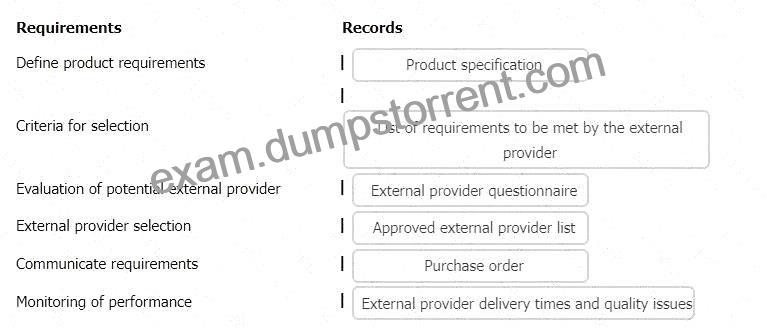
Q98. The following list gives examples of records that may be evidence of how an organisation has fulfilled the requirements of clause 8.4 of ISO 9001. Match the records to the appropriate requirement of clause 8.4.
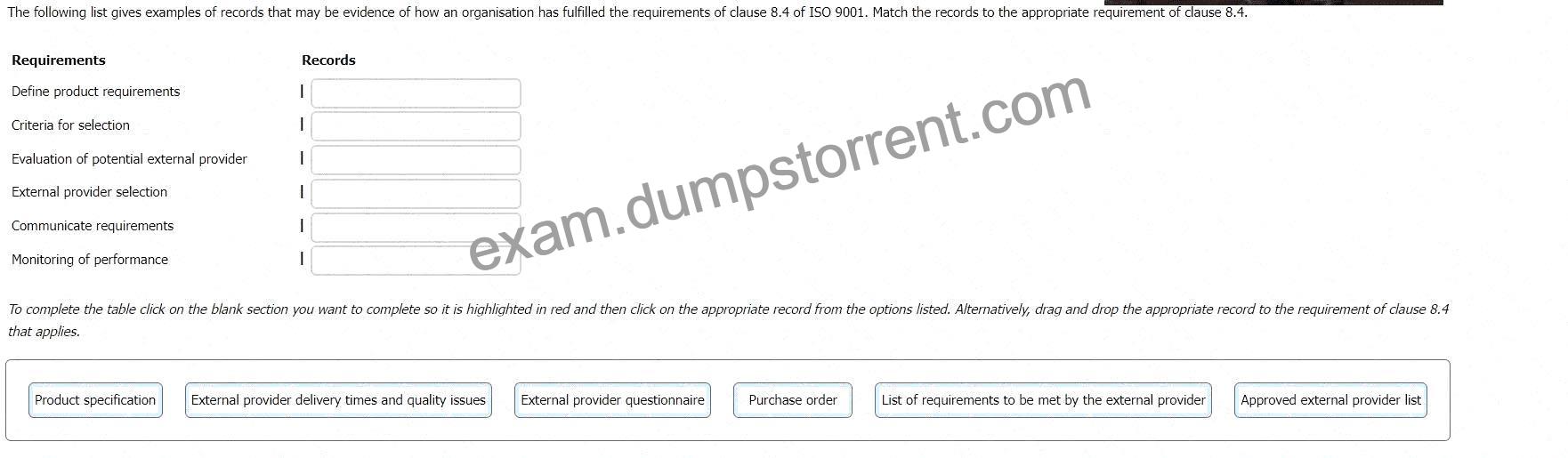
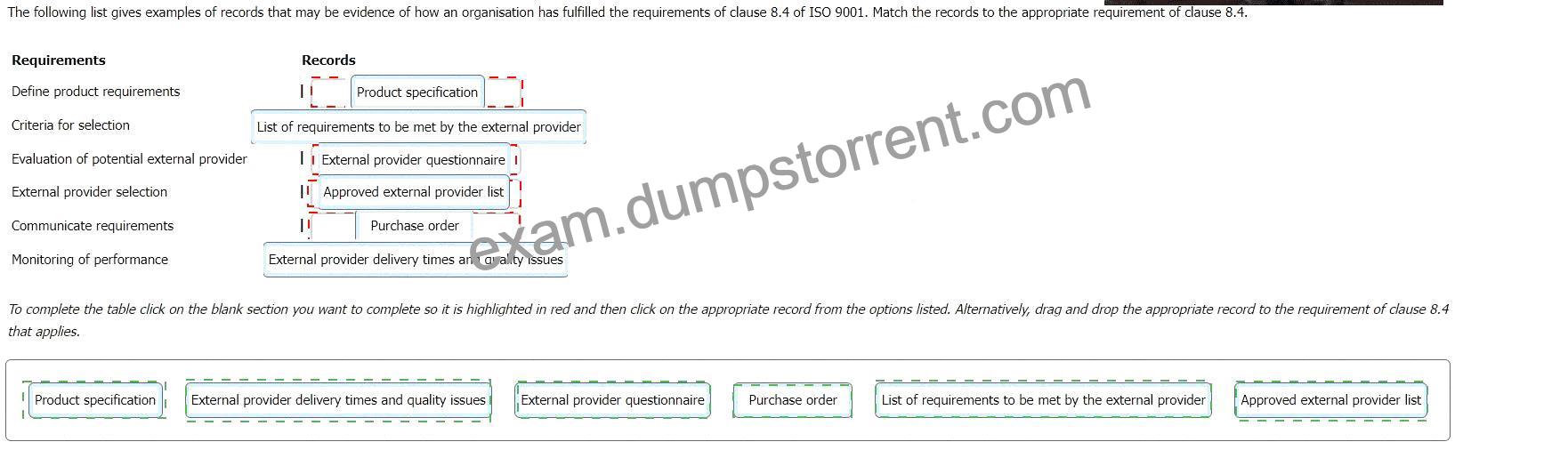
Q99. You are conducting a third-party audit to ISO 9001 and interviewing the Training Manager. She explains that training is more important than ever because the organisation has had to reduce the number of staff employed. Many of the remaining staff are now required to be ‘multi-skilled’. You ask to see plans for the multi-skilling training and are shown plans that look comprehensive, and include both ‘on the job” training and internal and external training courses.
The records indicate that several staff required parts of their training to be repeated one month after the first training was provided. You ask why this was needed and are told that an investigation of customer complaints identified that several staff members did not complete certain tasks in the correct manner. The extra training was therefore recommended as a corrective action.
Based on this interview, which two of the tollowing audit trails would be the most appropriate to follow?
Select the two most appropriate audit trails from the following.


Q100. What should the auditor document during the Stage 1 audit?


Q101. You are preparing an audit plan for a third-party ISO 9001 audit of organisation ABC that extracts lithium from mines in Bolivia.
ABC’s head office is in Lima, Peru, and it outsources all processes related to Production, Maintenance, Procurement and Human Resources to local Bolivian companies. ABC personnel manage in Bolivia only the Planning function.
Your plan starts in Lima, then you decide to go to Bolivia and fly back to Lima to audit the Quality Function and Top Management and conduct the closing meeting.
What would be your best decision when planning the audit in Bolivia?


PECB ISO-9001-Lead-Auditor Exam Syllabus Topics:

Topic Details
Topic 1
  • Preparing an ISO 9001 audit: This topic covers sub-topics related to preparing a quality management system audit.
Topic 2
  • Closing an ISO 9001 audit: The topic focuses on concluding a QMS audit and conducting audit follow-up activities.
Topic 3
  • Fundamental audit concepts and principles: Questions about interpreting and applying the main concepts and principles related to a QMS audit appear in this topic.
Topic 4
  • Quality management system (QMS) requirements: It assesses your abilities to point out and explain different requirements for a quality management system based on ISO 9001.
Topic 5
  • Managing an ISO 9001 audit program: This topic evaluates your abilities to establish and managing a QMS audit program.


Fully Updated Dumps PDF – Latest ISO-9001-Lead-Auditor Exam Questions and Answers: https://www.dumpstorrent.com/ISO-9001-Lead-Auditor-exam-dumps-torrent.html

Related Links: myportal.utt.edu.tt myportal.utt.edu.tt www.stes.tyc.edu.tw myportal.utt.edu.tt www.stes.tyc.edu.tw myportal.utt.edu.tt

Leave a Reply

Your email address will not be published. Required fields are marked *

Enter the text from the image below